From NSMs to Advisory Boards: Why Life Sciences Event Management Needs a More Connected Approach
Some of the most important events inside a life sciences organization never appear on a public congress calendar.
National Sales Meetings, POAs, advisory boards, investigator meetings, internal congress briefings, speaker programs, and training events all play different roles. Yet they share many of the same operational demands. Teams have to coordinate people, schedules, materials, sessions, communications, and follow-up across multiple stakeholders.
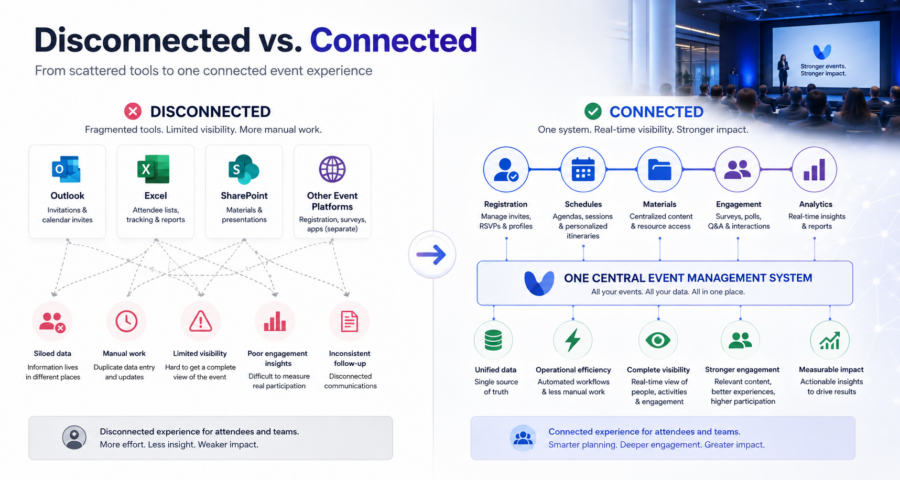
Despite that complexity, many internal events are still managed through a collection of familiar tools. Outlook handles invitations. Excel tracks attendees. SharePoint stores presentations. Other systems may manage registration, surveys, or individual pieces of the agenda.
Each tool can solve a specific need. The problem appears when teams need to understand the event as a whole.
Get the Gist
◆ Internal life sciences events require more visibility than calendar invitations and spreadsheets can provide.
◆ Registration, schedules, materials, feedback, and attendance work better when teams can manage them as part of one event experience.
◆ Engagement measurement should extend beyond who attended to how people participated and what they engaged with.
◆ Internal meetings influence congress strategy, KOL and HCP engagement, field execution, and future planning.
◆ The larger opportunity is connecting internal events to the broader life sciences engagement lifecycle.
1. Internal Events Carry More Complexity Than Meets the Eye
A National Sales Meeting may bring hundreds of people together for several days of general sessions, breakouts, product training, leadership meetings, and cross-functional discussions. A POA meeting can require similarly detailed coordination across field teams, Commercial leadership, training groups, and operations.
Smaller programs introduce a different kind of complexity. An advisory board may involve a limited number of participants, but the agenda, materials, discussion objectives, and follow-up can carry significant strategic value. Investigator meetings and speaker programs can add further coordination requirements around content, attendance, and communication.
Internal congress briefings create another layer. Medical Affairs, Commercial, operations, and leadership teams may need to align on schedules, scientific priorities, meetings, and responsibilities before anyone arrives onsite.
These events may differ in size and purpose, but the underlying need is consistent. Teams need an accurate view of who’s participating, what they’re attending, which information they need, and what happened as a result.
That becomes difficult when every part of the event lives somewhere different.
2. Outlook and Excel Can Only Carry the Process So Far
For a straightforward meeting, an Outlook invitation does exactly what it needs to do. It puts time on the calendar and allows attendees to respond.
That model becomes less reliable as the event grows.
An attendee may accept the main meeting invitation but still need to select breakouts, attend training sessions, review materials, complete surveys, or move between overlapping activities. A single calendar response can’t provide organizers with that level of visibility.
Spreadsheets often become the next layer. One file tracks attendees, another tracks sessions, and another may manage speakers, rooms, or responsibilities. SharePoint or another repository holds the latest presentations and resources.
The issue isn’t that these tools don’t work. It’s that teams have to piece together information from several places before they can answer basic operational questions.
Who has confirmed attendance? Which sessions are approaching capacity? Are two required sessions scheduled at the same time? Has the latest training material been distributed? Did attendees review it? Which topics generated questions or feedback?
As the event becomes more important, the cost of fragmented visibility increases with it.
3. Better Internal Event Management Creates One Reliable View
A stronger internal event model gives organizers and attendees a clearer place to understand what’s happening.
Registration and attendance tracking establish who plans to participate before the event begins. Centralized schedules give attendees a current view of sessions, meetings, and agenda changes. Conflict detection becomes particularly valuable when participants have several required activities competing for the same time.
Materials should follow the same principle. Presentations, training documents, agendas, and supporting resources are more useful when attendees can access them within the context of the event or session they support.
The experience can also provide information back to organizers.
Surveys, polling, feedback, and content engagement can reveal where attendees participated and where additional attention may be needed. Networking tools can help colleagues find the right people across functions, particularly during larger meetings where teams don’t normally work together.
After the event, that activity creates a stronger reporting foundation. Attendance still matters, but it becomes one part of a broader view that includes participation, content engagement, feedback, and follow-up.
This is where internal event management begins to move beyond logistics.
4. Internal Events Influence What Happens Outside the Meeting Room
The larger opportunity isn’t simply improving how one internal event is managed. It’s recognizing how that event connects to the work that follows.
An NSM or POA prepares field teams for the priorities they’ll carry into future customer and stakeholder interactions. Training events build the knowledge teams need before those conversations occur.
Internal congress briefings have an even more direct connection to external engagement. Teams use them to align on scientific priorities, responsibilities, schedules, and engagement plans before meeting HCPs and KOLs.
Advisory boards work in the opposite direction. They can generate scientific perspectives, identify questions, and reveal areas that deserve further exploration. Those insights may shape future congress conversations, evidence planning, or additional scientific exchange.
These activities aren’t isolated just because they happen in different rooms or systems.
When teams manage them separately, useful context can disappear between one stage and the next. The strategy discussed internally may not stay connected to the engagement that follows. Insights captured later may not make their way back into future preparation.
The result is an engagement lifecycle with gaps between important moments.

5. The Next Step Is Connecting Internal and External Engagement
Life sciences organizations already spend considerable effort preparing for high-value engagements. The challenge is maintaining continuity across them.
Instead of viewing each NSM, advisory board, congress, training program, or briefing as a separate project, teams can begin treating them as connected parts of a longer engagement strategy.
That changes what event data is expected to do.
Attendance information helps teams understand participation. Schedule data shows where time was spent. Material engagement can indicate what content people accessed. Surveys and feedback provide additional context about the experience.
When those signals remain available beyond the event, they can inform what happens next.
A congress team can enter preparation with better visibility into previous internal discussions. An advisory board can contribute context to future scientific engagement. Training participation can become part of understanding whether teams were prepared for subsequent responsibilities.
The value comes from retaining context instead of rebuilding it every time.
6. Build Internal Events Into the Broader Engagement Lifecycle
Event Cadence supports this approach by bringing registration, schedules, materials, surveys, engagement activity, and reporting into a more connected event environment.
For life sciences organizations, that capability can extend beyond a single company meeting. Internal events, advisory boards, congress activity, and other strategic engagements can contribute to a broader view of what happened, who’s involved, and what should happen next.
That visibility matters because an event rarely creates value in isolation.
The preparation that happens at an NSM influences later execution. A congress briefing shapes onsite engagement. An advisory board can inform future scientific conversations. Training prepares teams for the interactions they’re expected to manage.
Connecting those moments gives organizations a better way to preserve context across the engagement lifecycle.
About Event Cadence
Event Cadence helps life sciences organizations plan and manage complex events and engagements across congresses, company meetings, advisory boards, and other strategic programs. The platform connects scheduling, registration, content, engagement activity, and reporting while giving teams greater visibility before, during, and after each event.