How Life Sciences Teams Can Build a Pharma Event Prioritization Framework When Budgets Are Tight

Budget pressure doesn’t necessarily mean attending fewer events. It means being more deliberate about which events deserve investment.
For many life sciences organizations, the event calendar has grown more complex. Global congresses compete with regional meetings, advisory boards, investigator meetings, medical forums, and internal programs.
There are more opportunities to engage than most teams have resources to support equally.
A pharma event prioritization framework gives teams a consistent way to decide where budget, people, meeting space, and time can create the greatest value.
The goal isn’t simply to reduce spending. It’s to make sure investment reflects strategic opportunity.
Get the Gist
🎯 Prioritize around strategic value. An event’s size or history shouldn’t determine its investment level.
👥 Evaluate who you can engage. Priority KOL and HCP access often matters more than total attendance.
📊 Use historical performance. Meeting activity, outcomes, utilization, and follow-up can strengthen future planning decisions.
🏢 Right-size resources within each event. Meeting rooms, staffing, travel, and sponsorship deserve the same scrutiny as attendance.
🔄 Treat prioritization as a cycle. Each event should create intelligence that improves the next planning decision.
1. The Pharma Event Calendar Has Become a Prioritization Problem
Life sciences teams aren’t lacking opportunities to engage. The harder question is deciding which opportunities matter most.
A major global congress may seem essential because of its reputation. A smaller scientific meeting may offer better access to priority stakeholders.
An advisory board may require fewer resources while advancing an important scientific objective.
These opportunities shouldn’t automatically receive the same planning model or investment level.
Yet annual calendars are often shaped by precedent.
“We attended last year.”
“This is one of our major congresses.”
“We always reserve this much meeting space.”
Historical experience has value, but precedent alone isn’t a strategy.
Organizations need a repeatable way to distinguish between events that deserve significant investment and those requiring a more focused presence.

2. Move Beyond “We Went Last Year”
Budget scrutiny creates an important opportunity to question assumptions.
Consider a congress where 20 meeting rooms were booked, but only 11 saw consistent use. Perhaps staffing remained high despite relatively low meeting volume.
At another event, total attendance may have been smaller. Yet the team engaged more priority KOLs and generated more relevant follow-up opportunities.
Neither example automatically tells a team to attend or withdraw. Instead, they raise better questions.
How much of the investment was actually used? Who did the organization engage? What happened because of those interactions?
Were several internal teams pursuing the same stakeholders? Could the same objectives have been achieved with fewer resources?
This changes the conversation from cost reduction to investment alignment.
3. Build Prioritization Around Five Dimensions
Strategic importance
Start with alignment to current priorities. Consider therapeutic area relevance, scientific significance, market importance, competitive activity, and upcoming organizational milestones. An event with limited immediate meeting volume may still matter because of an important scientific development.
KOL and HCP opportunity
Then consider who is likely to participate. How many priority stakeholders will be present? What opportunities exist for focused, one-to-one engagement? Cross-functional demand matters too. Medical Affairs, Commercial, and Field Medical may all have legitimate interest in the same stakeholders.
Historical engagement
Past activity can provide valuable context. Review requested and completed meetings, attendance, repeat engagement, team participation, outcomes, and follow-up activity. The objective isn’t to reward volume. It’s to understand what previous investment produced.
Resource requirements
Registration is only one piece of event investment. Meeting rooms, travel, staffing, sponsorships, booth presence, ancillary programs, and internal coordination all require resources. These costs should be considered alongside the engagement opportunity.
Engagement potential
Finally, consider what the event could enable after it ends. Could conversations develop into future scientific exchanges, advisory boards, follow-up meetings, or deeper KOL relationships? Some of the most important value may occur months after the event itself.
4. Use a Pharma Event Prioritization Matrix
A simple pharma event prioritization matrix can make those decisions easier to discuss across functions.
Plot each event using two primary dimensions: Strategic Value × Engagement Opportunity.
That creates four practical categories.
| Tier | Strategic Value | Engagement Opportunity | Planning Approach |
| Tier 1: Prioritize | High | High | Invest significantly in planning, people, space, and coordination |
| Tier 2: Target | High | Lower | Maintain a focused presence around defined stakeholders and objectives |
| Tier 3: Evaluate | Lower | High | Investigate why activity is strong before increasing investment |
| Tier 4: Reduce | Lower | Lower | Consider reducing attendance, space, sponsorship, or participation |
The matrix shouldn’t become a rigid scoring exercise.
Different therapeutic areas may weight scientific importance differently. Commercial teams may have priorities that differ from Medical Affairs.
The value of the matrix is consistency. It creates a common starting point for deciding why an event matters and what level of investment it warrants.
5. Historical Data Changes the Planning Conversation
Prioritization gets stronger when teams aren’t rebuilding their assumptions every year.
Historical engagement data can answer questions that memory and spreadsheets can’t answer reliably.
Teams can examine meeting volume, stakeholder participation, scheduling conflicts, cancellations, room utilization, and cross-functional activity.
That makes a seemingly simple question far more useful.
Instead of asking, “How much meeting space did we book last year?”
Ask, “How much space did we actually use, and what engagement did that investment support?”
Meeting room intelligence is especially valuable here.
Event prioritization shouldn’t stop after deciding whether an organization should attend. Teams also need to determine how much to invest within that event.
Historical appointments and room utilization can help teams right-size space and staffing for the next cycle.
6. Prioritize the Engagement, Not Just the Event
An event isn’t valuable simply because it’s large, prestigious, or historically important. Its value comes from what the organization can accomplish there.
Consider one priority KOL across an entire year.
That individual may attend several congresses, join an advisory board, participate in a dinner program, and meet multiple internal teams.
When every interaction is planned independently, the organization sees separate events.
When those interactions are connected, the organization can see a relationship developing over time.
That distinction matters.
The better question isn’t only, “Which events should we prioritize?”
It’s also, “Which engagement opportunities within those events deserve our investment?”
That broader perspective can prevent duplicate outreach and help teams build on previous conversations.
7. Make Every Event Smarter Than the Last
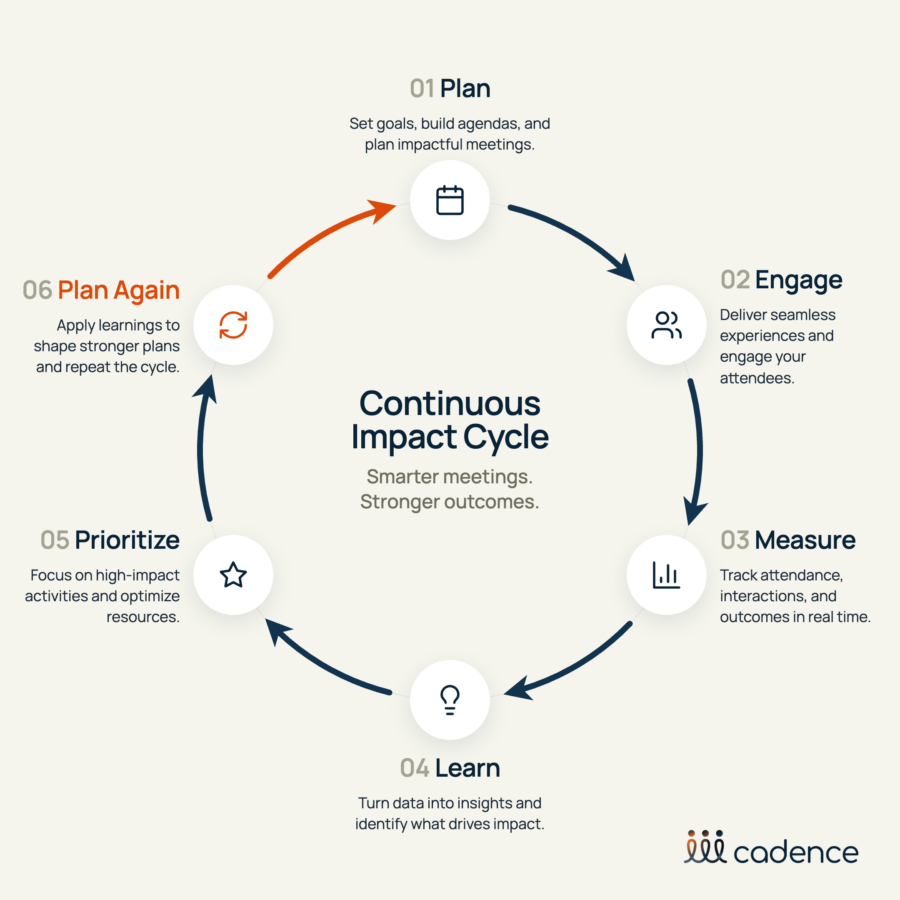
Event prioritization works best as a continuous planning cycle:
Plan → Engage → Measure → Learn → Prioritize → Plan Again
Each engagement should leave the organization with better information for the next decision.
That requires visibility across congresses, appointments, KOL and HCP engagement, meeting resources, and activity beyond major events.
Event Cadence helps life sciences teams connect that history across congresses and other engagements. Ensemble extends visibility across advisory boards and non-congress interactions.
Teams can examine appointment activity, stakeholder history, meeting room utilization, scheduling conflicts, and cross-functional participation in one connected view.
The result is a stronger basis for resource planning and executive reporting.
Over time, the planning question can evolve from “Where should we go?” to “Where can we create the greatest strategic value?”
Your historical event data should do more than document what happened. It should help determine what happens next.
See how Event Cadence can help your team prioritize the engagements that matter most.
About Event Cadence
Event Cadence helps life sciences organizations plan and manage congresses, meetings, and KOL/HCP engagements with greater visibility. By connecting planning, engagement activity, resources, and historical data, teams can use past experience