Life Sciences Event ROI Calculation Has to Move Beyond Vanity Metrics
Life sciences events have always been easier to count than to evaluate.
Registrations logged. Meetings held. Booth traffic reported.
Those numbers describe activity, but they don’t show whether an event advanced a scientific or commercial objective.
That difference matters under budget pressure. Leaders need to understand what changed because the event happened, not only what occurred during it.
A stronger Life Sciences Event ROI Calculation connects investment to financial return, scientific insight, relationship progress, and operational performance.
Get the Gist
📌 Life Sciences Event ROI Calculation should connect costs to outcomes, not activity alone.
🎯 Success has to be defined before the event, not reconstructed after it ends.
🔎 Financial ROI should sit beside scientific, strategic, and operational measures.
🤝 Meeting quality, insight capture, and next-step conversions show whether engagement progressed.
🧠 A useful ROI report should guide the next investment decision, not only defend the last one.
1. Define return before the event begins
The most common ROI problem starts before the event opens.
Teams often enter with broad goals such as awareness, engagement, or relationship building. Those goals sound reasonable, but they’re difficult to measure.
A stronger model defines the desired change before planning is complete. Each objective needs a clear measure and an agreed source of evidence.
For Medical Affairs, the objective may be closing a knowledge gap, testing a hypothesis, or capturing scientific sentiment.
For Commercial teams, it may be advancing a qualified opportunity, improving account access, or confirming a next step. The measure has to match the purpose.
This is the foundation of Return on Objective. Teams compare achieved value with the target established before the event.
When success isn’t defined early, teams default to what was easiest to count. That produces a report, but not a defensible view of return.
2. Capture the full event investment
ROI can’t be credible when the cost baseline is incomplete.
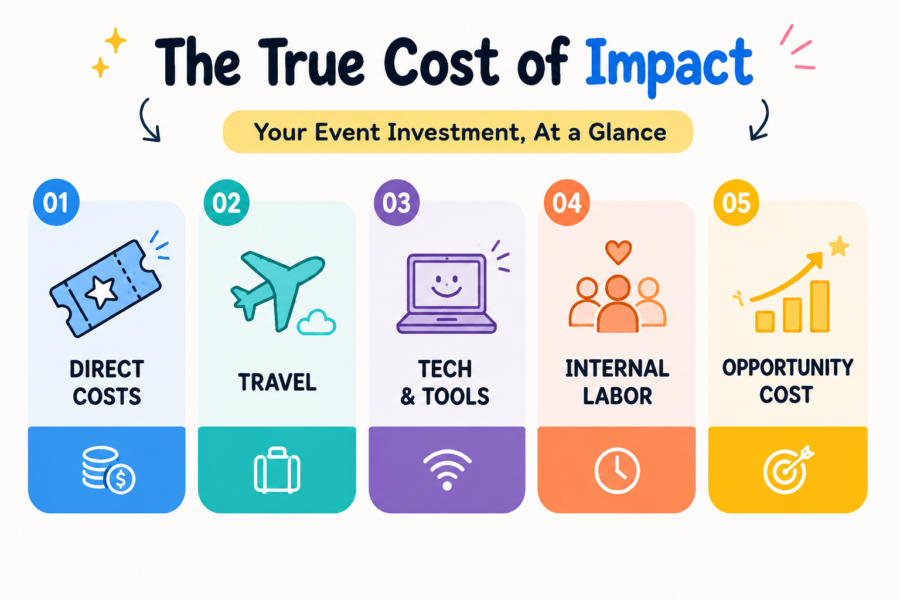
Registration fees and sponsorship packages are only part of the investment. Travel, technology, meeting space, production, and internal labor also matter.
Internal labor is often the least visible cost.
Teams spend time planning schedules, preparing briefing materials, resolving conflicts, entering data, and completing post-event reporting.
These hours represent real organizational capacity. A consistent labor estimate makes comparisons between events more useful.
Opportunity cost also deserves attention. Senior colleagues may spend days preparing for meetings or recovering context from disconnected systems.
Teams do not need a perfect number. They need a repeatable method that applies the same cost categories across comparable events.
3. Measure return across four dimensions
A single financial formula rarely captures the full value of a life sciences event.
Some outcomes can be translated into revenue or cost savings. Others create scientific, strategic, or operational value.
The strongest framework uses four connected dimensions.
Financial return measures attributed revenue, pipeline value, savings, or avoided cost.
Scientific return measures insight quality, evidence gaps identified, clinical needs surfaced, and influence on evidence strategy.
Strategic return measures KOL relationship progression, objective achievement, advisory participation, and credible next steps.
Operational return measures cost per meaningful interaction, room use, response rates, documentation quality, and administrative effort.
These dimensions shouldn’t compete with each other. They explain different parts of the same investment.
A leadership report becomes stronger when it shows both economic value and progress against the event’s strategic purpose.
The goal is not to force every outcome into dollars. It is to show how each outcome supports a decision.
4. Replace volume metrics with outcome signals
Activity metrics still provide useful context. They show scale, reach, and participation.
But scale does not prove value.
A full calendar may contain many low-value interactions. A smaller program may produce fewer meetings and stronger strategic progress.
The better question is what advanced because those interactions happened.
Outcome measurement should focus on scientific relevance, objective achievement, relationship progression, and next-step conversion.
Scientific relevance asks whether the discussion advanced understanding, alignment, or perspective.
Objective achievement asks whether the engagement fulfilled the purpose defined before the event.
Relationship progression asks whether the interaction deepened the scientific or commercial relationship.
Next-step conversion asks whether the engagement produced a specific follow-up with an owner and timeline.
Together, these measures help teams separate motion from momentum. They also reveal where future investment should increase or change.

5. Build a report that supports decisions
A Life Sciences Event ROI report shouldn’t end with a dashboard.
It should explain the investment, the intended outcomes, the results, and the decision those results support.
A useful report answers five questions.
What did the organization invest? Which goals was the event expected to achieve? Which key activities took place? How has the situation shifted? Where should efforts focus moving forward?
The report should include the total investment, objective results, outcome signals, and any attributed financial value.
It should also show where the measurement has limits. Attribution rules, data gaps, and assumptions should be stated clearly.
This makes the calculation easier to defend.
It also prevents false precision. Scientific insight and relationship progress should not receive artificial dollar values without a credible method.
The final section should recommend action. Leaders need to know whether to increase investment, reduce spend, change audience strategy, or improve follow-up.
ROI becomes useful when it changes what the organization does next.
6. The next model is connected, consistent, and outcome-driven
The future of event measurement will depend on how well teams connect planning, execution, insight capture, and reporting.
Life sciences leaders don’t need more isolated records. They need visibility that links objectives, engagements, outcomes, and costs across the event lifecycle.
That means moving from attendance to achievement. It means replacing raw volume with evidence of scientific, strategic, and operational progress.
It also means treating each event as part of a longer engagement strategy. The value of one congress often continues through follow-up and future interactions.
Event Cadence supports this approach by connecting event planning, engagement activity, and outcome capture in one shared view.
For life sciences teams, the opportunity is not only better reporting. It is a more credible way to decide where event investment creates the greatest return.
Connect with our team to explore how Event Cadence can support consistent event planning, outcome capture, and ROI reporting.
About Event Cadence
Event Cadence helps life sciences organizations plan, coordinate, and measure high-value engagements across congresses, meetings, advisory boards, and other strategic programs. Teams gain the visibility needed to align stakeholders, capture insight, and connect event activity to outcomes that matter.