KOL Engagement Strategy Has to Move Beyond Volume

For years, KOL engagement has been easier to count than to understand.
Meetings held. Touchpoints logged. Calendars filled.
Activity can look impressive on a dashboard, but it doesn’t always show whether scientific understanding advanced.
That difference matters more now. Medical Affairs teams are being asked to defend investment, prove strategic value, and show how expert engagement supports scientific objectives. More activity isn’t enough. Better visibility, stronger intent, and clearer outcomes are becoming the new standard.
The next evolution of KOL engagement strategy isn’t about collecting more data. It’s about connecting data to purpose, continuity, and progress.
Get the Gist
📌 KOL engagement strategy has to shift from volume metrics to outcome-based measurement.
🎯 Success should be defined before an engagement begins, not after it ends.
🔎 Budget pressure makes visibility and prioritization more important, not less.
🤝 Congresses, advisory boards, and meetings should build one connected scientific narrative.
🧠 Real value comes from turning engagement data into strategic intelligence.
1. Strategy has to come before data
Too often, teams capture engagement data after the fact.
The record may show who met, when they met, and what topics were covered. That helps with documentation, but it rarely drives strategy on its own.
If success is only measured after the interaction, teams are always working from hindsight. A stronger model starts earlier. Before the first question is asked, the team defines the scientific purpose of the engagement.
That purpose might be testing a hypothesis, closing a knowledge gap, understanding scientific sentiment, or preparing for evidence strategy. The important point is that the objective exists before the conversation begins.
When objectives are clear, data capture becomes more intentional. Teams aren’t just recording that engagement occurred. They’re capturing whether the engagement advanced the purpose it was designed to support.
This is where closed-loop engagement becomes valuable. Planning, execution, and outcomes are connected. Patterns become visible across conversations, not buried in disconnected notes.
For Medical Affairs leaders, the practical question is simple. Can your team see whether engagement activity is moving scientific objectives forward? If not, more data may only create more noise.
2. Budget pressure exposes the difference between activity and value
Budget constraint doesn’t reduce the need for KOL engagement. It raises the standard for what engagement has to prove.
When resources tighten, teams have to make harder choices. High-frequency activity matters less than high-value interaction. A crowded calendar can no longer stand in for strategic progress.
That shift changes the conversation with leadership.
Instead of reporting how much engagement occurred, Medical Affairs teams need to show what each engagement produced. Did the discussion clarify a scientific gap? Did it support alignment? Did it create a credible next step?
This kind of outcome-based reporting helps reposition engagement from expense to investment. It also gives teams a clearer way to defend where resources should go next.
Budget pressure can make teams more focused. It forces prioritization, sharper preparation, and stronger follow-through. The risk is that teams make decisions without enough visibility.
Without connected insight, teams may cut or repeat activity without understanding which interactions created the most value. Visibility makes investment decisions more defensible. It shows where focus should increase, where activity should change, and where engagement isn’t producing enough strategic return.

3. Purposeful conversations respect expert time
A KOL’s time is one of the most valuable resources in Medical Affairs. Yet many conversations still default to updates, broad agendas, or open-ended check-ins.
Those formats may feel productive in the moment. They often fail to create scientific progress.
A thirty-minute meeting can be a strategic milestone, or it can become another calendar entry.
The difference is intent.
High-impact conversations usually have one to three focused objectives. They center on a defined scientific question, gap, hypothesis, or decision point. They also end with a clear next step.
This structure isn’t about limiting dialogue. It creates the conditions for a better one. Clear intent shows that the team has prepared, respects the expert’s perspective, and understands what the conversation needs to accomplish.
The challenge is consistency.
Intent can disappear between meetings when objectives and outcomes aren’t captured in a shared view. One team may know the context, while another starts over.
That creates friction for experts. It also weakens scientific credibility. The more senior the KOL, the less patience they’ll have for conversations that don’t build on what came before.
Purposeful conversations require more than good agendas. They need objective tracking, outcome capture, and continuity across teams.
4. Continuity matters more than isolated events
Major congresses often receive the most planning energy. That makes sense. They bring teams, experts, and scientific priorities into the same environment at the same time.
But congress strategy can become too episodic.
The event begins, the meetings happen, the booth comes down, and critical insight sits in a silo until the next planning cycle.
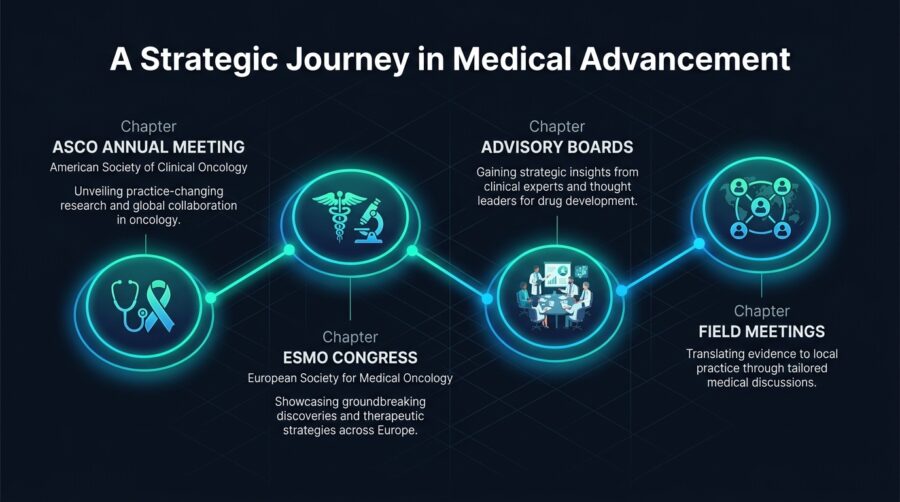
This reset mentality slows momentum. It also creates a weaker experience for experts. If a team asks at ESMO what was already discussed at ASCO, the issue isn’t only wasted time. It signals that the scientific story isn’t connected.
KOL engagement is relational, not episodic.
Each conversation should build on prior context. Each congress should become a chapter in a larger scientific narrative.
Continuity depends on three capabilities.
First, teams need context retention, so they know where the last conversation ended. Second, they need scientific progression, so each interaction builds on prior insight. Third, they need relationship maturity, so engagement grows in relevance over time.
None of this happens through effort alone.
When insight lives across inboxes, spreadsheets, slides, and personal notes, the storyline breaks. Teams may still be working hard, but they’re working from fragments.
Connected visibility changes the operating model. It helps teams understand what has been learned, what needs to happen next, and how each engagement contributes to scientific progress.
5. Measurement has to show what actually moved
Meeting counts are easy to report. They’re also easy to overvalue.
If a dashboard only shows how many meetings happened last quarter, it doesn’t show whether those meetings mattered. Busy doesn’t mean effective.
The better question is what advanced because the engagement happened.
Did the expert’s perspective evolve? Did the team close a knowledge gap? Did the conversation inform evidence strategy? Did it create a meaningful follow-up?
Outcome-driven measurement gives Medical Affairs a stronger language for value. It moves teams from counting touchpoints to assessing scientific relevance, objective achievement, and directional progress.
Scientific relevance asks whether the discussion advanced understanding or alignment.
Objective achievement asks whether the conversation met the purpose defined before it began.
Directional progress asks whether the interaction created a clear next step.
Together, these signals create a more useful view of engagement. They help teams distinguish motion from momentum.
This also strengthens the role of Medical Affairs. Strategic engagement shouldn’t be treated as a tactical expense. It’s an investment in scientific advancement, relationship quality, and better decision-making.
6. The next model is connected, intentional, and outcome-driven
The future of KOL engagement strategy will be defined by how well teams connect activity to purpose.
Medical Affairs leaders don’t need more isolated records of engagement. They need visibility that helps them plan with intent, execute with precision, and understand outcomes in real time.
That means moving from activity to impact. It means replacing volume with value. It means treating congresses, advisory boards, and field conversations as connected parts of one scientific relationship.
It also means turning data collection into strategic intelligence. Data becomes more valuable when it helps teams decide what to do next.
Event Cadence supports this shift by helping teams move from silos to sync. Ensemble provides visibility across the KOL engagement lifecycle, from planning and execution to real-time capture and post-engagement insight.
For Medical Affairs teams, the opportunity isn’t just better reporting. It’s a stronger way to understand whether engagement is advancing scientific objectives.
Connect with our team to explore how Event Cadence can help your organization build more intentional, connected, and outcome-driven KOL engagement.
About Event Cadence
Event Cadence helps life sciences organizations plan, coordinate, and measure high-value engagements across congresses, meetings, advisory boards, and other strategic programs. Through Ensemble, teams gain the visibility needed to align stakeholders, capture insight, and connect engagement activity to outcomes that matter.